Learn.
Genetics 101
Genetics Glossary: A to Z
Every technical term you'll meet in your DNA report, explained plainly. Organised by difficulty so you can start with the basics and go as deep as you want.
Published March 31, 2026
Summary
Every technical term you'll meet in a DNA report or a genetics paper, organised by the depth you actually need. Start at Beginner — DNA, gene, chromosome, allele, genotype, phenotype, mutation, and heredity — then go deeper into SNPs, polygenic scores, haplotypes, linkage disequilibrium, epigenetics, gene expression, and penetrance. The Advanced tier covers GWAS, PGS/PRS, MAF, Hardy-Weinberg equilibrium, imputation, LD score regression, pleiotropy, and epistasis. Each entry gets a plain-English definition and a concrete example from real genetics — usually anchored to ACTN3, BRCA1, or other variants you'll meet across the rest of the Learn section. Read once; come back later.
In this article
1. Beginner: the fundamentals
2. Intermediate: going deeper
3. Advanced: the bigger picture
4. References
1. Beginner: the fundamentals
Level 1
These are the essentials for understanding any genetics article or DNA report. Start here.
DNA (Deoxyribonucleic Acid)
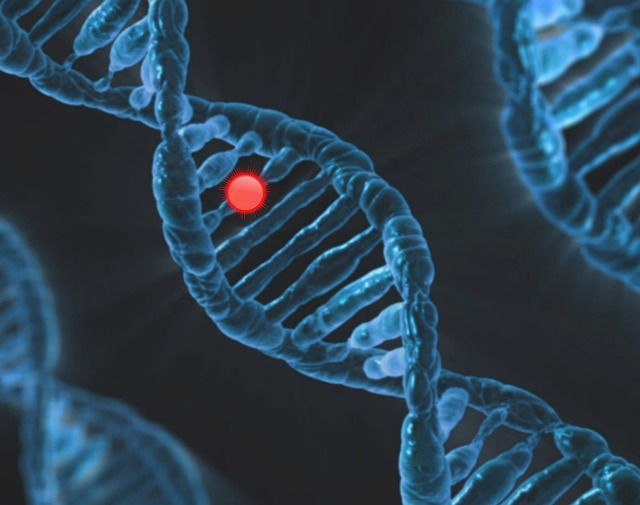
The molecule that carries your genetic instructions. DNA is a double helix made of four chemical bases — adenine (A), thymine (T), guanine (G), and cytosine (C) — attached to a sugar-phosphate backbone. The sequence of these bases encodes everything needed to build and run every cell in your body.
Your entire genome is roughly 3.2 billion base pairs of DNA.
Gene
A stretch of DNA that contains the instructions for making a protein or a functional RNA molecule. Genes are the basic units of heredity. Humans have around 20,000–25,000 protein-coding genes, which together make up only about 1.5% of the genome.
ACTN3 is a gene that codes for alpha-actinin-3, a protein found in fast-twitch muscle fibres.
Chromosome
A long, continuous DNA molecule wrapped around structural proteins called histones. Humans have 23 pairs of chromosomes — 46 in total. You inherit one set of 23 from each parent. Chromosomes 1–22 are autosomes; the 23rd pair determines biological sex (XX or XY).
The ACTN3 gene sits on chromosome 11.
Allele
One of two or more versions of a gene or genetic variant. At any given position in your DNA, you carry two alleles — one inherited from each parent. Different alleles can produce different effects on whatever trait the gene influences.
At SNP rs1815739, the two alleles are C and T. You can carry CC, CT, or TT.
Genotype
The specific combination of alleles you carry at a particular genetic position (or across your whole genome). Your genotype is fixed at conception and does not change over your lifetime.
A "CT" genotype at rs1815739 means you carry one C allele and one T allele.
Phenotype
The observable characteristics that emerge from your genotype interacting with your environment. Phenotypes include physical traits (height, eye colour), biochemical traits (enzyme activity), and performance traits (VO2max, sprint speed).
Two people with the same genotype can have different phenotypes thanks to differences in training, nutrition, and lifestyle.
Mutation
A permanent change in DNA sequence. In everyday language "mutation" tends to imply something harmful, but in genetics the term is neutral — it simply means a change. When a mutation becomes common enough in a population (above 1% frequency), it's usually called a polymorphism instead.
The ACTN3 R577X "mutation" is carried by roughly 30% of Europeans — making it a polymorphism.
Heredity
The passing of genetic information from parents to offspring. Each parent contributes one allele at every genetic position, producing the child's unique combination. Heredity is why traits like eye colour and certain disease risks run in families.
If both parents are CT at ACTN3, their child can be CC, CT, or TT.
2. Intermediate: going deeper
Level 2
These terms show up often in DNA reports and the scientific literature. Knowing them helps you read your results with more nuance.
SNP (Single Nucleotide Polymorphism)
A single-base change in DNA sequence that's present in at least 1% of the population. SNPs are the most common form of genetic variation, occurring roughly once every 300 base pairs. Each SNP gets a unique "rs" identifier (for example, rs1815739).
Consumer DNA tests typically read between 600,000 and 900,000 SNPs from your sample.
Polygenic Score (PGS)
A single number that summarises the combined effect of many genetic variants on a particular trait. It's calculated by multiplying each variant's effect size (its weight) by the number of effect alleles you carry, then summing across all variants. Polygenic scores are usually expressed as percentiles relative to a reference population.
An endurance PGS at the 85th percentile means your genetic predisposition for endurance-related traits is higher than 85% of the reference population.
Haplotype
A group of alleles at neighbouring positions on the same chromosome that tend to be inherited together. Because recombination (crossing-over) during meiosis is less likely between variants that sit close together, nearby alleles often pass from parent to child as a single block.
The HLA region on chromosome 6 contains haplotypes strongly tied to immune function and autoimmune disease risk.
Linkage Disequilibrium (LD)
The non-random association of alleles at different positions. When two SNPs are in strong LD, knowing the allele at one position lets you predict the allele at the other with high probability. LD is why genotyping chips can capture information about millions of variants while only directly measuring a subset of them.
If SNP A and SNP B are in strong LD, and a GWAS detects an association at SNP A, the true causal variant might actually be SNP B.
Epigenetics
Chemical modifications to DNA or to histone proteins that change gene expression without altering the underlying DNA sequence. The two main mechanisms are DNA methylation (adding methyl groups to silence genes) and histone modification (changing how tightly DNA is packed). Epigenetic changes can be influenced by exercise, diet, stress, and ageing.
A single bout of exercise can shift DNA methylation patterns in muscle cells within minutes.
Gene Expression
The process by which the information in a gene is used to produce a functional protein (or RNA molecule). Gene expression is regulated at multiple stages — transcription, RNA processing, translation — and can be turned up or down by signals from the environment. A gene that is "expressed" is being actively read and translated.
The ACTN3 gene is expressed only in fast-twitch muscle fibres, not in other tissues.
Penetrance
The proportion of people carrying a given genotype who actually show the associated phenotype. A 100%-penetrant variant always produces the trait. Many variants involved in complex traits have incomplete penetrance — carrying the "risk" allele doesn't guarantee the outcome.
BRCA1 breast-cancer variants are highly but not fully penetrant (~70%). The ACTN3 R577X mutation is very highly penetrant for the absence of the protein — TT carriers produce essentially no alpha-actinin-3.
3. Advanced: the bigger picture
Level 3
These terms appear in scientific papers and in the methods sections of technical reports. You don't need them to understand your report, but they'll help you assess the science behind it.
GWAS (Genome-Wide Association Study)
A study design that scans the genomes of large groups of people for statistical associations between genetic variants and traits or diseases. GWAS typically test hundreds of thousands to millions of SNPs and need very large sample sizes (tens of thousands to millions of participants) to detect the small effect sizes of individual variants.
The largest height GWAS included over 5 million participants and identified more than 12,000 associated SNPs.
PGS (Polygenic Score) / PRS (Polygenic Risk Score)
Abbreviations for polygenic scores. PGS is the more general term (used for any trait). PRS specifically refers to disease-risk prediction. Both are calculated the same way. The PGS Catalog (pgscatalog.org) curates a database of more than 4,000 published scores, with documented weights and performance metrics.
A type-2 diabetes PRS can flag individuals at "monogenic-equivalent" risk using common variants alone.
MAF (Minor Allele Frequency)
The frequency of the less-common allele at a given SNP position in a specified population. Variants with MAF above 5% are considered common; 1–5% are low-frequency; below 1% are rare. MAF varies between populations — an allele that's common in East Asia can be rare in Europe.
The T allele at rs1815739 (ACTN3) has a MAF of around 48% in Europeans, but only about 10% in some African populations.
Hardy-Weinberg Equilibrium (HWE)
A mathematical principle stating that allele and genotype frequencies in a population stay constant from one generation to the next in the absence of evolutionary forces (mutation, selection, migration, drift). Departures from HWE in genetic data can signal genotyping errors, population stratification, or selection pressure.
GWAS quality control routinely tests every SNP for HWE — significant deviations usually point to technical artefacts rather than real biological signals.
Imputation
A statistical method for inferring untyped variants from those that were genotyped, using the linkage-disequilibrium patterns of a reference panel (such as the 1000 Genomes Project or TOPMed). Imputation lets genotyping chips that directly measure 600,000 SNPs effectively "fill in" millions of additional variants with high accuracy.
With the 1000 Genomes map we use, imputation estimates about 78 million positions. Most are rare variants that almost nobody carries; what counts are the few million where you differ.
LD Score
A summary statistic used in LD score regression (LDSC), a method that estimates heritability and genetic correlations from GWAS summary statistics — without needing individual-level data. A SNP's LD score is the sum of its squared correlations (r²) with all neighbouring SNPs.
LDSC analysis has shown that endurance performance and injury risk share a meaningful genetic correlation — the same variants that boost endurance capacity may also lower the risk of soft-tissue injuries.
Pleiotropy
When a single gene or variant influences multiple, seemingly unrelated traits. Pleiotropy is the rule rather than the exception — most genes participate in several biological pathways, so a variant affecting one pathway often has downstream effects on others.
The ACTN3 R577X variant affects not just muscle-fibre composition but also bone mineral density, thermoregulation, and possibly recovery speed — a textbook case of pleiotropy.
Epistasis
An interaction between variants in different genes, where the effect of one variant depends on the genotype at another. Epistasis is one reason single-SNP analyses can miss important genetic effects — a variant may only have an impact when a second variant in another gene is also present.
ACTN3 and ACE may show an epistatic interaction: the endurance advantage of the ACTN3 TT genotype could be amplified in individuals who also carry the ACE II genotype.
4. References
Primary sources used to compile this glossary.
- Alberts B et al. Molecular Biology of the Cell, 6th edition. Garland Science, 2014. — Standard graduate-level reference.
- Griffiths AJF et al. Introduction to Genetic Analysis, 12th edition. W.H. Freeman, 2020. — Undergraduate genetics reference.
- Visscher PM et al. "10 years of GWAS discovery: biology, function, and translation." Am J Hum Genet, 2017;101(1):5-22. PMID: 28686856
- Buniello A et al. "The NHGRI-EBI GWAS Catalog of published genome-wide association studies." Nucleic Acids Res, 2019;47(D1):D1005-D1012. PMID: 30445434
- Lambert SA et al. "The Polygenic Score Catalog as an open database for reproducibility and systematic evaluation." Nat Genet, 2021;53(4):420-425. PMID: 33692568
- Bulik-Sullivan BK et al. "LD Score regression distinguishes confounding from polygenicity in genome-wide association studies." Nat Genet, 2015;47(3):291-295. PMID: 25642630
Ready to see your genetics in action?
Now that you speak the language, explore what your DNA actually says about your body.
Order your reportIf you believe any information in this article is inaccurate or outdated, please let us know. We continuously review and update our content based on the latest peer-reviewed research to ensure the highest accuracy.