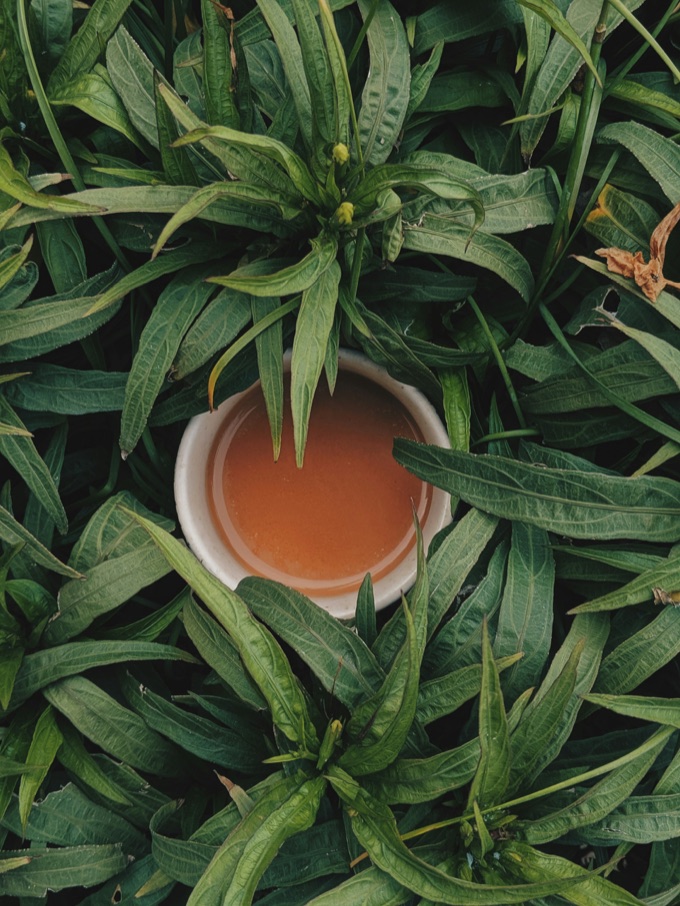
L-Theanine: The Tea Molecule That Takes the Edge Off Caffeine
L-theanine is why a cup of tea feels calmer than the same caffeine in coffee — a relaxing amino acid that steadies you without making you sleepy. Its standout use is pairing with caffeine for smooth, jitter-free focus. Here's what it really does, why the caffeine stack is the point, and the honest truth about how little your genes have to say about it.
1. What L-theanine is — and what it does
L-theanine is an amino acid found almost uniquely in the tea plant (and a few mushrooms). It's the reason a cup of green tea delivers a gentler, more focused kind of alertness than an equivalent hit of coffee. Once absorbed, it crosses into the brain and nudges several calming systems — it influences GABA, glutamate, dopamine and serotonin signalling and, most characteristically, increases alpha brain waves, the electrical pattern linked to a state of relaxed, wakeful attention.
The practical effect is a sense of "calm alertness": less mental noise and tension, without the drowsiness you'd get from a sedative. On its own, L-theanine produces a modest reduction in stress and a subtle steadying of attention. It doesn't knock you out and it isn't a stimulant — it takes the edge off arousal while leaving you clear-headed.
2. Genes & L-theanine — an honest, indirect link
We'll be straight with you: there's no established gene variant that predicts your response to L-theanine. Unlike caffeine — where CYP1A2 clearly shapes the outcome — theanine has no comparable "responder" genotype. Anyone selling a personalised-theanine story is ahead of the evidence.
What genetics can add is context through the systems theanine touches. Its best-supported role is calming caffeine, and caffeine's downside — anxiety and jitters — is strongly shaped by ADORA2A (the adenosine-receptor gene). So the people whose ADORA2A wiring makes caffeine feel anxious and wired are exactly the ones a caffeine + theanine stack is built to help. Your DNA doesn't tell you "theanine works for you" — but it can tell you whether you're the caffeine-sensitive type who has the most to gain from pairing it.
L-theanine earns Tier-2 evidence for reducing stress and — most convincingly — for improving attention and smoothing side effects when combined with caffeine; its solo effects are real but mild. We rate the genetic link Tier 3 (indirect): no variant predicts theanine response, but ADORA2A flags who is caffeine-sensitive and therefore stands to benefit most from the stack. We won't pretend your genes choose theanine for you — we'll show you the caffeine-sensitivity picture that makes the pairing sensible.
3. The caffeine stack — its real killer app
Caffeine + L-theanine together. This is the combination with the strongest evidence: theanine blunts caffeine's jitteriness and blood-pressure bump while the two together improve attention and accuracy more than caffeine alone. If coffee makes you sharp but frazzled, this stack is the fix.
On its own for stress or wind-down. Useful before a stressful event, or in the evening to quiet a racing mind without sedation (it won't knock you out). The effect is subtle — a helpful nudge rather than a dramatic calm — so set expectations accordingly.
Because theanine isn't sedating, it's popular as an evening companion to reduce mental chatter, and as a daytime tool to take the anxious edge off caffeine or a stressful stretch. It won't cause a "crash" and doesn't build the kind of tolerance stimulants do — its downside is simply that, used alone, it's easy to under-notice.
4. Forms & what to look for
L-theanine (capsules/powder)
Standard supplemental theanine is well absorbed and inexpensive. Look for products specifying "L-theanine" (the biologically active form); some branded versions (e.g. Suntheanine) guarantee the pure L-isomer, which is a reasonable quality marker but not essential.
Caffeine + L-theanine combos
Many nootropic and pre-workout products sell the pair pre-mixed, commonly around a 2:1 theanine-to-caffeine ratio (e.g. 200 mg theanine + 100 mg caffeine). Convenient, but check the actual amounts — and remember you can just as easily take plain theanine alongside your coffee.
Tea
Green tea (and especially shade-grown types like matcha and gyokuro) naturally contains both theanine and caffeine — the original stack. Great as a habit, but the dose per cup is modest and variable if you want a specific effect.
5. Food — tea, and why supplements go further
Tea is essentially the only meaningful dietary source of L-theanine, and it's a lovely one — a typical cup provides something in the region of 25 mg, alongside its caffeine. That's enough to contribute to tea's famously calmer buzz, but well below the 100–200 mg used in most studies. So drinking tea gives you the authentic, gentle version; a supplement lets you hit the studied dose reliably and tune the theanine-to-caffeine ratio to taste. Neither is "better" — they're different tools.
6. Dosing, timing & the ratio
Typical doses run 100–200 mg, taken as needed rather than on a schedule; theanine works acutely, within an hour, so there's nothing to "load." For the caffeine stack, a roughly 2:1 theanine:caffeine ratio is the common starting point — for example 200 mg theanine with 100 mg caffeine. For evening calm, theanine alone is the move, since you don't want the caffeine.
For focus: pair ~100–200 mg L-theanine with your caffeine (aim near 2:1) about an hour before you need to concentrate. For stress or sleep onset: take 100–200 mg on its own, and keep caffeine out of it. Adjust the ratio by feel — more theanine for a calmer tilt, less for a sharper one.
7. Safety
L-theanine has an excellent safety profile — it's naturally present in a widely-consumed beverage, is well tolerated in studies up to several hundred milligrams, and doesn't cause dependence or a crash. Side effects are rare and mild. The main sensible cautions are that it can mildly lower blood pressure and may add to the effect of sedative or blood-pressure medications, so check with a doctor if that applies to you, and — as with any supplement — during pregnancy. Otherwise it's about as low-risk as supplements come.
8. The science
9. References
- Kimura K, Ozeki M, Juneja LR, Ohira H. L-Theanine reduces psychological and physiological stress responses. Biol Psychol. 2007;74(1):39-45. PMID: 16930802.
- Haskell CF, Kennedy DO, Milne AL, et al. The effects of L-theanine, caffeine and their combination on cognition and mood. Biol Psychol. 2008;77(2):113-122. PMID: 18006208.
- Rogers PJ, Smith JE, Heatherley SV, Pleydell-Pearce CW. Time for tea: mood, blood pressure and cognitive performance effects of caffeine and theanine administered alone and together. Psychopharmacology (Berl). 2008;195(4):569-577. PMID: 17891480.
- Hidese S, Ogawa S, Ota M, et al. Effects of L-theanine administration on stress-related symptoms and cognitive functions in healthy adults: a randomized controlled trial. Nutrients. 2019;11(10):2362. PMID: 31623400.
10. Related reading
Does caffeine leave you wired?
If coffee makes you sharp but jittery, your ADORA2A genetics may be why — and it's exactly the profile the caffeine + L-theanine stack is built for. KortexDNA reads your caffeine-sensitivity genes so you can pair your stimulants intelligently, not by trial and error.
Get Your ReportIf you believe any information in this article is inaccurate or outdated, please let us know. We continuously review and update our content based on the latest peer-reviewed research to ensure the highest accuracy.