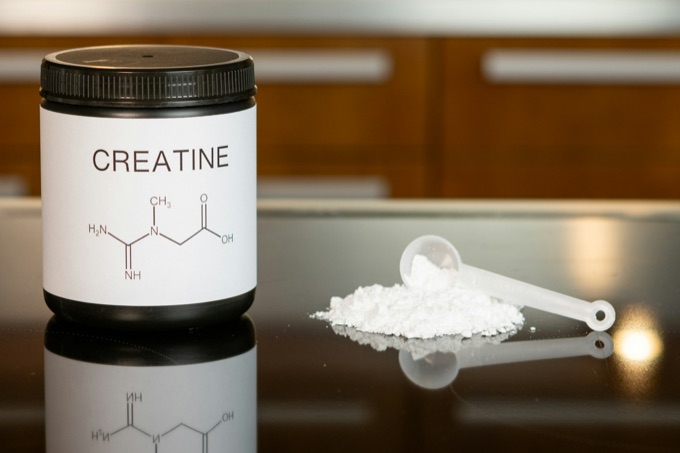
Creatine: The Most Proven Supplement — and the Gene Myth
It is the most studied performance supplement in history, and it works for nearly everyone. Here is what it actually does, who responds most, and why the "DNA-matched creatine" pitch doesn't hold up.
1. What creatine is — and what it actually does
Creatine is a compound your body already makes — in the liver and kidneys — and stores mostly in muscle as phosphocreatine. During short, intense efforts (a heavy set, a sprint, a jump), phosphocreatine donates a phosphate to regenerate ATP, the cell's immediate energy currency, faster than any other pathway. The catch: your muscles' phosphocreatine tank is small and empties quickly.
Supplementing creatine tops up that tank. With more phosphocreatine on hand, you can squeeze out a little more force, a few more reps, before fatigue sets in. None of that builds muscle by itself — but over weeks, that extra training stimulus compounds into well-documented gains in strength, power, and lean mass, with smaller benefits for high-intensity repeat efforts and even cognition under stress.
2. Genes, creatine & where the hype outruns the evidence
You'll sometimes see creatine sold as "genetically targeted," usually pointing at two genes: CKM (rs1803285), which codes for creatine kinase — the very enzyme that shuttles phosphate to and from creatine — and AMPD1 (rs17602729), involved in ATP recycling. The mechanism sounds compelling.
So we'll be straight with you: there are no published studies showing that CKM or AMPD1 genotype predicts who responds to creatine. The biochemical link is plausible, but plausibility is not proof. As a supplement, creatine sits at the top tier of evidence; as a genetically targeted product, the targeting claim sits at the bottom — mechanism only.
Creatine is Tier-1 evidence as a supplement, but genotype-based targeting is Tier-3 (mechanism only). We recommend creatine on its general merits — not as a "DNA-matched" product. Being evidence-led sometimes means telling you a gene story is hype, even when it would be easier to sell.
3. Who responds most
The real predictor of response isn't a gene — it's how much creatine is already in your muscles. The further below saturation you start, the more there is to gain:
Vegetarians, vegans, and low-meat eaters. Dietary creatine comes almost entirely from meat and fish, so plant-based eaters start with the most room to fill — and tend to show the largest jumps in muscle creatine, strength and lean mass.
Frequent meat-eaters. A diet already rich in red meat and fish keeps muscle stores closer to full, so there's less to add. Most so-called "non-responders" are simply people already near their natural ceiling.
Response is also easy to see wrongly: a 1–2 kg bump on the scale in the first weeks is mostly water drawn into muscle, not fat — a sign it's working, not a side effect to fear.
4. Forms: monohydrate vs the rest
Creatine monohydrate
The gold standard — the form used in the overwhelming majority of studies, the cheapest, and the one every position stand recommends. There is no good reason to start anywhere else.
Creatine HCl
Dissolves more easily in water, which some people prefer, but it has no proven advantage in results over monohydrate — usually just a higher price.
Micronized monohydrate
Monohydrate ground into finer particles so it mixes faster. Same molecule, same efficacy — a convenience tweak, nothing more.
5. Food first
Creatine occurs naturally in animal foods: red meat (roughly 2 g per pound of steak), fish, and to a lesser extent poultry. Cooking degrades some of it, and reaching a supplemental 3–5 g daily from food alone means eating a lot of meat — which is exactly why plant-based eaters benefit most from a supplement. For omnivores, diet keeps stores partly topped up; the supplement closes the gap.
6. Dosing, timing & loading
The simple, evidence-backed protocol is 3–5 g per day, every day, taken at any time — with or without food, before or after training. Taking it with carbohydrates may slightly improve uptake, but the difference is small. Consistency matters far more than timing.
An optional loading phase — about 20 g/day split into 4 doses for 5–7 days — saturates muscle faster. Skip it and a steady 3–5 g still reaches full saturation in roughly 3–4 weeks. There is no need to cycle creatine on and off.
7. Safety & the creatinine confusion
Creatine is one of the most thoroughly studied supplements in existence — well over a thousand studies — with a strong safety record. In healthy people, it does not harm the kidneys.
The lab-test catch. Creatine slightly raises serum creatinine, a marker doctors use to estimate kidney function. This is a harmless by-product of having more creatine in your system — not kidney damage — but it can make a routine blood test look abnormal. If you have kidney bloodwork coming up, tell your doctor you take creatine so the result isn't misread.
Mild water-weight gain in the first weeks is normal and expected. Anyone with existing kidney disease, or who is pregnant, should check with a doctor first.
8. The science
9. References
- Kreider RB, Kalman DS, Antonio J, et al. International Society of Sports Nutrition position stand: safety and efficacy of creatine supplementation in exercise, sport, and medicine. J Int Soc Sports Nutr. 2017;14:18. PMID: 28615996.
- Antonio J, Candow DG, Forbes SC, et al. Common questions and misconceptions about creatine supplementation: what does the scientific evidence really show? J Int Soc Sports Nutr. 2021;18(1):13. PMID: 33557850.
- Buford TW, Kreider RB, Stout JR, et al. International Society of Sports Nutrition position stand: creatine supplementation and exercise. J Int Soc Sports Nutr. 2007;4:6. PMID: 17908288.
10. Related reading
Where does your DNA actually change the answer?
Creatine works for nearly everyone — so genetics adds little. KortexDNA focuses your effort on the nutrients and training levers where your DNA genuinely shifts the recommendation.
Get Your ReportIf you believe any information in this article is inaccurate or outdated, please let us know. We continuously review and update our content based on the latest peer-reviewed research to ensure the highest accuracy.