Quercetin: A Real Food Compound Behind a Wall of Hype
Quercetin is the pigment that makes onions oniony and apples good for you — a dietary flavonoid with genuine anti-inflammatory and antihistamine activity. It went viral as an "immune" and antiviral supplement, but that's where the evidence is thinnest. Its quieter, real effect is on blood pressure. Here's what quercetin actually does, why so little of a capsule gets absorbed, and where your genes give context.
1. What quercetin is — and what it does
Quercetin is a flavonoid — one of the most abundant plant polyphenols in the human diet, giving colour and bioactivity to onions (especially red), apples, capers, berries, kale and tea. In the lab it's a jack-of-several-trades: a solid antioxidant, an anti-inflammatory that dampens inflammatory signalling, and — most distinctively — an antihistamine, stabilising the mast cells that release histamine in allergic reactions. It also relaxes blood vessels a little.
Those mechanisms are genuine and appealing, which is why quercetin gets marketed for everything from allergies to immunity to athletic performance. The catch, as so often, is the gap between what a compound does in a dish and what it does in a person swallowing a capsule — and for quercetin, that gap is unusually wide.
2. Genes & quercetin — an indirect link
There's no gene that predicts your response to quercetin. What genetics offers is context about the systems it touches. Because quercetin's most credible effect is on blood pressure and blood vessels, genes like NOS3 — which governs your production of nitric oxide, the molecule that dilates vessels — describe the vascular terrain quercetin acts on. And because it's an anti-inflammatory, inflammation genes such as IL6 describe how strongly your body inflames in the first place.
So the honest read mirrors curcumin's: your DNA won't tell you "take quercetin," but it can describe your vascular and inflammatory profile — the backdrop against which a mild vasodilating, anti-inflammatory polyphenol might matter more or less. It's context for a lifestyle-and-diet decision, not a prescription.
We rate quercetin Tier 2 (modest) for lowering blood pressure — the effect is real but small, and clearest at higher doses and in people who are already hypertensive. We rate it Tier 3 for allergy relief (mechanistically plausible, thin human data) and for endurance (a small, inconsistent boost). The popular antiviral/immune claims we rate unproven. The genetic link is Tier 3: vascular and inflammation genes (NOS3, IL6) give context, not a verdict. Our guidance: eat quercetin-rich foods freely, consider a supplement mainly if blood pressure is your target (and use an absorbable form), and discount the immune marketing.
3. What the evidence actually supports
Blood pressure. Meta-analyses show quercetin modestly lowers blood pressure, with the effect strongest at doses of 500 mg/day or more and in people who already have hypertension. This is quercetin's most solid human result.
Allergies — its mast-cell/antihistamine action is a real mechanism, but human trials are limited and preliminary. Endurance — some studies show a small rise in exercise capacity, but the effect is minor and inconsistent. Reasonable to try, modest to expect.
4. The "immune/antiviral" hype
Quercetin's biggest surge in popularity came from claims that it fights viral infections — partly because it can act as a "zinc ionophore," helping zinc enter cells, and because of lab studies against various viruses. During the pandemic it was widely promoted, often paired with zinc and vitamin C, as an immune defence.
Here's the honest position: these ideas rest largely on test-tube and theoretical evidence, not robust human trials. There is no solid clinical proof that quercetin supplements prevent or treat viral infections in people. The mechanism is interesting and worth researching — but "interesting mechanism" is not "proven benefit," and buying quercetin as antiviral insurance is buying a hypothesis, not a result.
5. The absorption problem
Like curcumin, quercetin has a serious bioavailability limitation: standard quercetin (usually sold as quercetin dihydrate) is poorly absorbed, so much of a dose never reaches your blood in an active form. This is a big reason human results are more muted than the lab mechanisms suggest. Formulators try to fix it with enhanced forms — phytosome (bound to phospholipids), enzymatically-modified isoquercetin (EMIQ), or combinations with vitamin C or bromelain said to aid uptake. As with curcumin, a plain, cheap quercetin product may deliver disappointingly little; the delivery system matters.
6. Forms & combinations
Quercetin dihydrate
The standard, inexpensive form used in many studies — effective enough to show blood-pressure effects at adequate doses, but limited by poor absorption.
Enhanced-absorption forms
Phytosome quercetin and EMIQ are designed for better uptake, and are a sensible choice if you want a real chance of an effect. They cost more, with the usual caveat that marketing can outpace evidence.
Quercetin + bromelain / vitamin C
Common in "allergy" and "immune" formulas; bromelain and vitamin C are added partly to aid absorption. Reasonable combinations, though the added ingredients don't rescue thin underlying evidence for those uses.
7. Food — onions, apples & the case for eating it
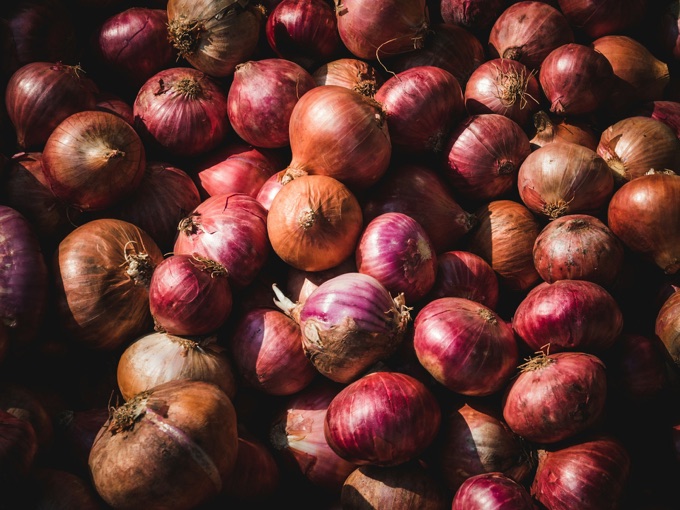
Quercetin is, first and foremost, a food compound, and getting it from food has real advantages: it arrives alongside other beneficial flavonoids and nutrients, and a diet rich in these plant polyphenols is consistently associated with better cardiovascular health. The richest sources are onions (especially red onions and the outer layers), apples (with skin), capers, kale, broccoli, berries, black and green tea, and red wine. A diet built around colourful vegetables, fruit and tea supplies quercetin as part of a package that outperforms any isolated pill — which is exactly why "eat the onion" is genuinely reasonable advice here.
8. Dosing & safety
Supplemental doses are typically 500–1000 mg/day, with the blood-pressure evidence strongest at the higher end; an absorbable form matters more than a big number on a poorly-absorbed one. Quercetin is generally safe at these doses short-to-medium term, with occasional headache or stomach upset. Cautions: very high doses (over ~1000 mg/day) long-term haven't been well studied and there are theoretical kidney concerns; like curcumin, quercetin can inhibit drug-metabolising enzymes (CYP450) and so may raise levels of some medications (including certain blood thinners, antibiotics and cyclosporine). Check with a doctor before use if you take medication, have kidney issues, or are pregnant.
9. The science
10. References
- Edwards RL, Lyon T, Litwin SE, et al. Quercetin reduces blood pressure in hypertensive subjects. J Nutr. 2007;137(11):2405-2411. PMID: 17951477.
- Kressler J, Millard-Stafford M, Warren GL. Quercetin and endurance exercise capacity: a systematic review and meta-analysis. Med Sci Sports Exerc. 2011;43(12):2396-2404. PMID: 21606866.
- Serban MC, Sahebkar A, Zanchetti A, et al. Effects of quercetin on blood pressure: a systematic review and meta-analysis of randomized controlled trials. J Am Heart Assoc. 2016;5(7):e002713. PMID: 27405810.
- Mlcek J, Jurikova T, Skrovankova S, Sochor J. Quercetin and its anti-allergic immune response. Molecules. 2016;21(5):623. PMID: 27187333.
11. Related reading
Is blood pressure your reason?
Quercetin's most credible benefit is a modest drop in blood pressure — and your vascular genetics, like NOS3, shape how your vessels behave to begin with. KortexDNA reads your cardiovascular and inflammation genes so you can judge polyphenols like quercetin on your real profile, not on immune-season hype.
Get Your ReportIf you believe any information in this article is inaccurate or outdated, please let us know. We continuously review and update our content based on the latest peer-reviewed research to ensure the highest accuracy.